With an intensity I would soon learn is part of his conversational DNA, he added, “Thank you, Jesus, and thank you, Toyota Tacoma!”
Fish Out of Water
Less than two weeks after the near-miss, Mokhnenko and I sat together in an exhibition hall in Grapevine, Texas, at the International Christian Media Convention hosted by National Religious Broadcasters (NRB). He was there as a guest of Great Commission Media Ministries (GCM), a global alliance of evangelistic and humanitarian organizations. I was following a lead on a story that took less time than expected.
If you are familiar with my writing and know anything about NRB, then you’ll surmise I felt like a fish out of water at the conservative media event. Think Alexandria Ocasio-Cortez walking around a Turning Point USA convention.
After rage-watching Eric Metaxas on a live podcast disparage the masculinity of pastors who refuse to support Donald Trump publicly, and then joy-watching pastor Greg Locke stand alone at a book-signing table with no one in line, I considered canceling my hotel reservation and heading back to Waco. But as I was walking out of the exhibition hall, a large GCM booth prominently displaying the yellow and blue of the Ukrainian flag caught my attention.
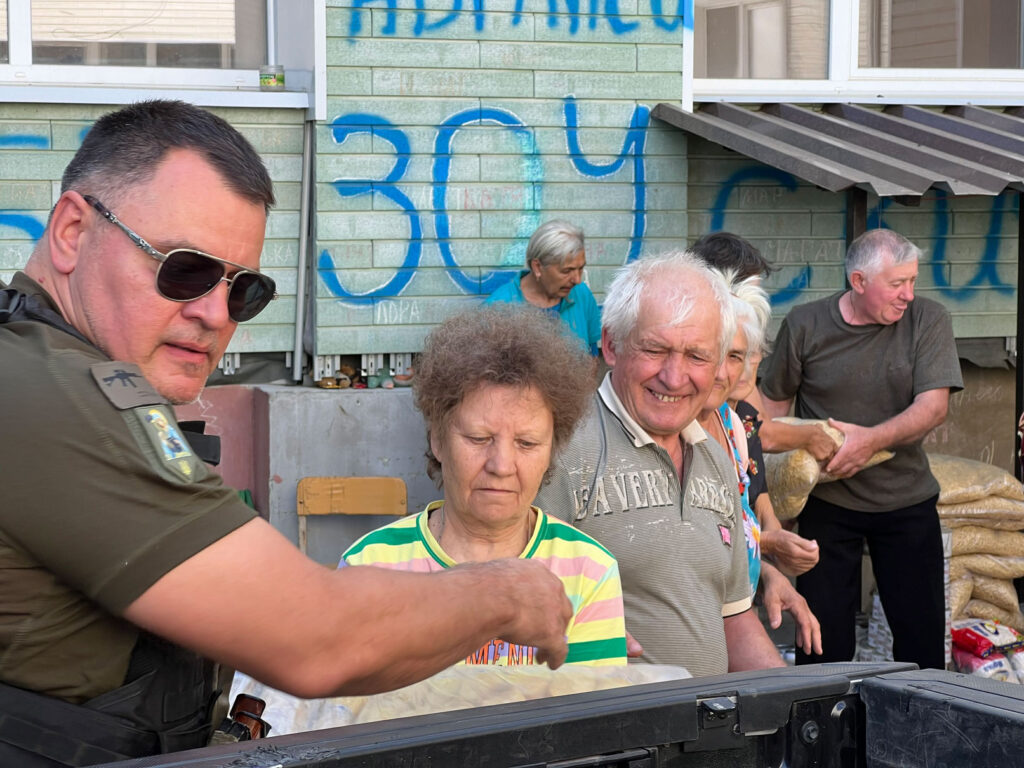
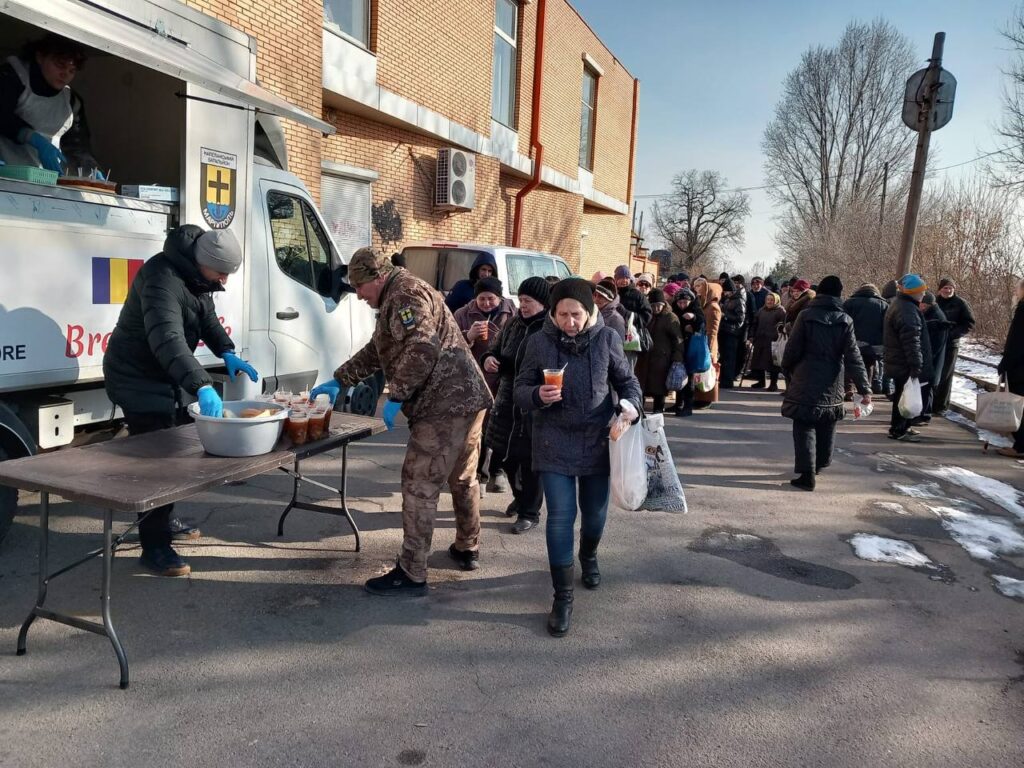
After meandering around the perimeter of the display—intrigued but hoping to go unnoticed—I ended up talking to Dr. Hannu Haukka, GCM’s founder and CEO. Since the war began, his ministry has been providing emergency aid to Ukrainian families suffering from the brutal Russian attacks.
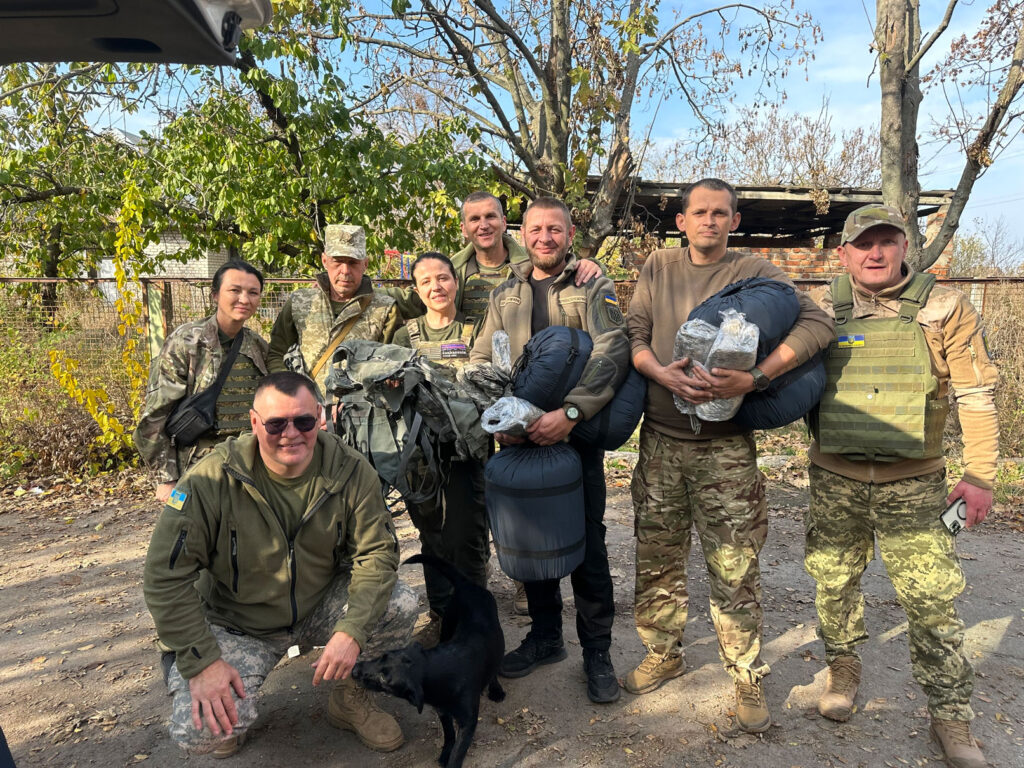
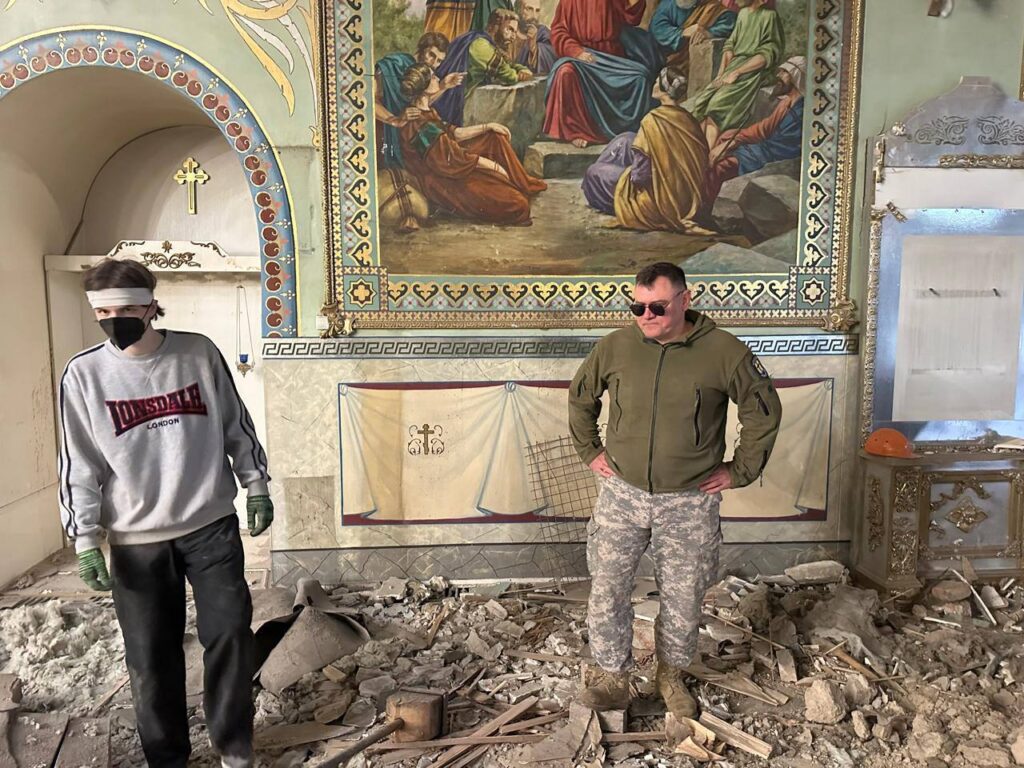
GCM’s mission is similar to that of many of the other exhibitors at the convention–evangelistic and buttressed by a dispensationalist theology that focuses on Israel and the salvation of Jews around the world. However, their booth featured a group of Ukrainian soldiers, highlighting their work on the battlefield and in bombed-out cities.
This intrigued me, given that we were surrounded by Trump-supporting evangelicals amid the president’s recent signals that he may sever U.S. support for Ukraine in the war. So I asked Haukka about it, wondering aloud what that was like for him and his guests.
I sensed my question gave him permission to let his guard down, knowing he was in more hospitable company regarding Ukraine than those in the surrounding booths.
We talked about the parable of the sheep and goats in Matthew 25. He and I bonded over our common appreciation that, in the parable, the basis for salvation wasn’t belief, faith, or grace but how we respond to those in most desperate need. He told me he didn’t know if others at the convention appreciated what a gift it was to have his Ukrainian guests there.
After our conversation, I kept my hotel reservation and returned the next day.
Under Siege
When I arrived the following morning, Haukka wasn’t there, so I went directly to the table in the middle of the display to introduce myself to Mokhnenko. He is a strong, confident man whose presence makes him appear a foot taller than he actually is. Within seconds, he began telling me his story in broken English with a thick Slavic accent.
(I have edited portions of our conversation for clarity.)
“I’ve been a pastor for 33 years,” he told me. “I am a bishop from Mariupol, but my city is no more. Russia blockaded my city, tens of thousands of people have been killed, and no one is talking about it.”
He said he can’t get in touch with 30% of his phone book, presuming they are dead. This includes Mokhnenko’s brother, sister and one of his daughters. “It’s a modern-day genocide,” he said, repeating what would become a common refrain, “and no one is talking about it.”
At the beginning of the siege of Mariupol, Mokhnenko led a mission that evacuated over 8,000 people. “No one else would do it,” he said. “The Red Cross wouldn’t do it. The United Nations wouldn’t do it. But my team, mostly my sons, raced through the checkpoints, with the Russians shooting, and evacuated all those people.”
Mokhnenko’s wife fell ill a few days before the invasion but was able to escape to Western Europe, where she remains with some of their children.
Less than five minutes into our conversation, more of his children appeared in his stories. Along with those with his wife, some have settled in East Texas (coincidentally, around where I am from) and others in Western Ukraine. In addition to the daughter who lost her life, several sons are fighting on the front lines of the war.
I finally asked the question I was beginning to realize would be key to understanding Gennadiy Mokhnenko’s story: “How many kids do you have?”
He replied, “I have 43 children. Only three of them are biological.”
Almost Holy
The collapse of the Soviet Union in the 1990s ushered in a period of economic collapse and social unrest in Ukraine.
Several factors, including corruption within law enforcement, Soviet-style drug laws focused on punishing users rather than traffickers, and its location at the crossroads of the Afghan poppy trade, led to epidemic-level drug misuse on the streets of Ukraine’s cities. From this, Mokhnenko, then a young minister in the Church of God, emerged in Mariupol as a maverick, self-appointed social services agent, crime fighter, chaplain and rehabilitation officer.
At night, he would pull drug-addled youth off the streets and bring them to his church to sober up. He confronted pharmacists who sold synthetic heroin to known drug dealers. He rescued women from abusive husbands and pimps.
Mokhnenko’s vigilante ministry was featured in the 2015 documentary Almost Holy. Early in the film, someone questioned his authority to do the things he did, reminiscent of the questioning leveled at early believers in the book of Acts.
“People asked me, ‘Who gave you the right to do this?’” he said. “I don’t know. I don’t need permission to do good deeds.”
Trauma-informed social workers and ministers will rightly find reasons to bristle at his tactics revealed in the film. Mokhnenko describes himself as a “social orphan,” the child of alcoholic parents, and so psychologists will easily connect the dots between that reality and his superhero complex.
However, none of that matters to hundreds of rehabilitated Ukrainians, forty of whom Mokhnenko and his wife adopted. He brought them from darkness to light and gave them a purpose.
Mokhnenko’s orphanage became known as “Pilgrim Republic” and was heralded by many in the region, including Russian leaders, as a beacon of hope.
“Before the war,” he told me, “I took my sons on a bicycle tour around the world. They threw concerts for me in Russia and cried, ‘Oh, pastor, you are so amazing.’ But then the war began, and the Russian ambassador to the United Nations started calling us a ‘terrorist training camp for children.’”
Russian disinformation and how it has crept into American discourse and policy decisions would quickly become a topic of our conversation.
Putin’s Evangelicals
I asked Mokhnenko about being a chaplain on the battlefield. He began to summarize a typical day when we were interrupted by security officers who wanted to talk to him. These men were in plain clothes, but one had a side arm visible underneath his sports coat.
They pulled him aside, and after I realized this could end with Mokhnenko’s removal from the property, I began to listen in on the conversation. It ended peacefully, however, with one of the men saying he “understands how emotions are elevated during these times.” At our table, Mokhnenko explained everything.
During the morning breakfast in the exhibition hall, one of his sons, a soldier in fatigues, recognized the American pastor of an evangelical Moscow megachurch sitting at a nearby table. Mokhnenko told me, “This is a famous pastor in Russia, and when my son told me he was sitting at the next table, I told myself, ‘Don’t turn your head,’ because I didn’t want to get myself in trouble.”
His son, however, saw a media opportunity. (We were, after all, at a media convention.) He pulled out his phone, prepared to ask the pastor what he thought about Putin’s genocide in Ukraine. Before he could hit the record button, the pastor ran off (apparently to get security).
Similar to the ascension of Donald Trump onto the American political scene, Vladimir Putin’s war in Ukraine fractured Protestant Christians in Russia. A 2023 Christianity Today article described the fault lines.
There had long been unity among Russian and Ukrainian evangelicals, with Ukraine being the largest supplier of missionaries to the lands of their former occupiers. So when some Russian believers began to see Instagram photos of their Ukrainian siblings pleading for help, they spoke up.
However, these were few and far between, with some outspoken ministers being jailed or disappearing, and others leaving the country. Most remained silent, either passively condemning or supporting the war.
This was pastor Rick Renner’s tact for much of his thirty-year ministry in Russia. Renner, who founded the Good News Church in Moscow after the fall of the Soviet Union, had long taken a neutral, apolitical approach to what goes on in the Kremlin. History has shown this to be the best strategy for religious leaders prioritizing self-preservation.
But in an October 2022 sermon, eight months after the invasion, Renner preached from First Timothy 2, a text used for millennia to silence opposition to unjust leaders. “In the New Testament,” he said, “never, not once, can we find an endorsement for disrespecting authority.”
He went on to “tone police” the prayers of those under brutal political systems and encouraged Christian leaders to refrain from critiquing those in power. Given its timing, many observers, including Mokhnenko, took this as a tacit approval of Putin’s devastating actions in Ukraine.
As he reflected on Renner’s words, Mokhenko said, “Adolf Hitler had many bishops who stayed around him and blessed his systems, who blessed his genocide. And now we have many Christian leaders blessing what Putin is doing in Ukraine.”
But there are courageous pastors as well, according to Mokhnenko: “I know amazing Russian pastors who said true things about this war, and they are now in prison. I know a bishop who openly called it a ‘genocide,’ and he is now dead.”
A “Freedom Country”
Mokhnenko loves the United States, having grown up listening to “Voice of America,” the government-owned radio network created to counter Nazi and Soviet propaganda.
“Because of this,” he told me, “I understand when I hear Russian propaganda from the radio or TV. But when I hear these Russian ideas from an American President, like ‘Zelensky is a dictator,’ but won’t call Putin one, it is crazy for me.”
He added: “I question many things about Zelensky, of course. But when I hear your president say, ‘He’s just an unsuccessful comedian,’ I just don’t understand it. This is a man who is the leader of a country who, every day for three years, has had the blood of soldiers, women and children flowing in the streets. But I still pray for the United States and believe that his mind can be changed. I am thankful for the American mass media correcting him when he says these things.”I asked Mokhnenko one thing he would say to people of faith in America.
He replied, “I want to tell them that the war in Ukraine is not about gas or land. It isn’t an ‘ethnic conflict’ between Russians and non-Russians.” (Mokhnenko is a native Russian speaker.) “It is a real battle about freedom. Russia wants to bring us back into its prison. Ukraine is a ‘freedom country.’ We have free elections, free speech, and freedom of religion. Putin wants to take all that away.”
Less than 24 hours after our conversation, Volodymir Zelensky sat in the Oval Office with the U.S. President and Vice President yelling Putin’s propaganda at him as they actively worked to sever ties with our Ukrainian allies.
The Karamazov Connection
Gennadiy Mokhnenko is not a perfect man. He’s rough around the edges, a product of decades of geopolitical strife, cultural formation, and an internal disposition incapable of suffering fools lightly.
But he is also a disciple of a justice-loving God who holds us all accountable–not for what we believe about Jesus or how we pray but for our actions when confronted with suffering and oppression.
In addition to Christian scriptures, Mokhnenko was shaped by Russian literary masters such as Solzhenitsyn, Tolstoy, and his favorite, Dostoevsky. In “Almost Holy,” he pointed to a passage from “The Brother’s Karamazov” that was integral to his story.
“This book built my soul. It built my understanding. This built my world and my life,” he said before reading the words of Alyoshka, one of the Karamozov brothers Mokhnenko first read when he was 15 years old: “I’m not rebelling against my God; I simply don’t accept his world.”
This is the challenge of Matthew 25: to refuse to accept the world as it is. Gennadiy Mokhnenko leans into this challenge and demands we accept it–for the sake of his children, our neighbors, and the world.